
The digital world thrives on personalization, from predictive text suggestions to tailored product recommendations. Yet, this convenience often comes with a trade-off: the sharing of vast amounts of personal data with centralized servers. A quiet but profound revolution is underway, however, as advancements in on-device AI and federated learning are fundamentally reshaping how artificial intelligence operates, promising a future where powerful personalization coexists with robust user privacy.
The Growing Imperative for Privacy-Preserving AI
For years, the dominant paradigm for AI model training involved collecting user data, sending it to cloud servers, and processing it in centralized data centers. While effective, this approach raised significant concerns about data security, potential breaches, and compliance with increasingly stringent privacy regulations like GDPR and CCPA. The public’s demand for greater control over their personal information has spurred innovation, leading to a paradigm shift towards decentralized intelligence.
Understanding the Decentralized AI Paradigm
At the heart of this revolution are two interconnected technologies:
On-Device AI: Intelligence at the Edge
On-device AI refers to the capability of artificial intelligence models to run directly on a user’s local device—be it a smartphone, laptop, smart home gadget, or wearable—without constant reliance on cloud connectivity. This means that tasks like speech recognition, image processing, and even complex natural language understanding can occur locally.
The rapid proliferation of specialized hardware, such as Neural Processing Units (NPUs) and AI accelerators embedded within modern chipsets, has been a critical enabler for this shift. These dedicated components are designed to execute AI workloads with remarkable efficiency, consuming less power and delivering faster results than traditional CPUs or GPUs for these specific tasks.

The benefits are manifold: enhanced privacy (as data never leaves the device), reduced latency (no round trip to the cloud), and improved reliability (functionality even without an internet connection).
Federated Learning: Collaborative Intelligence, Private Data
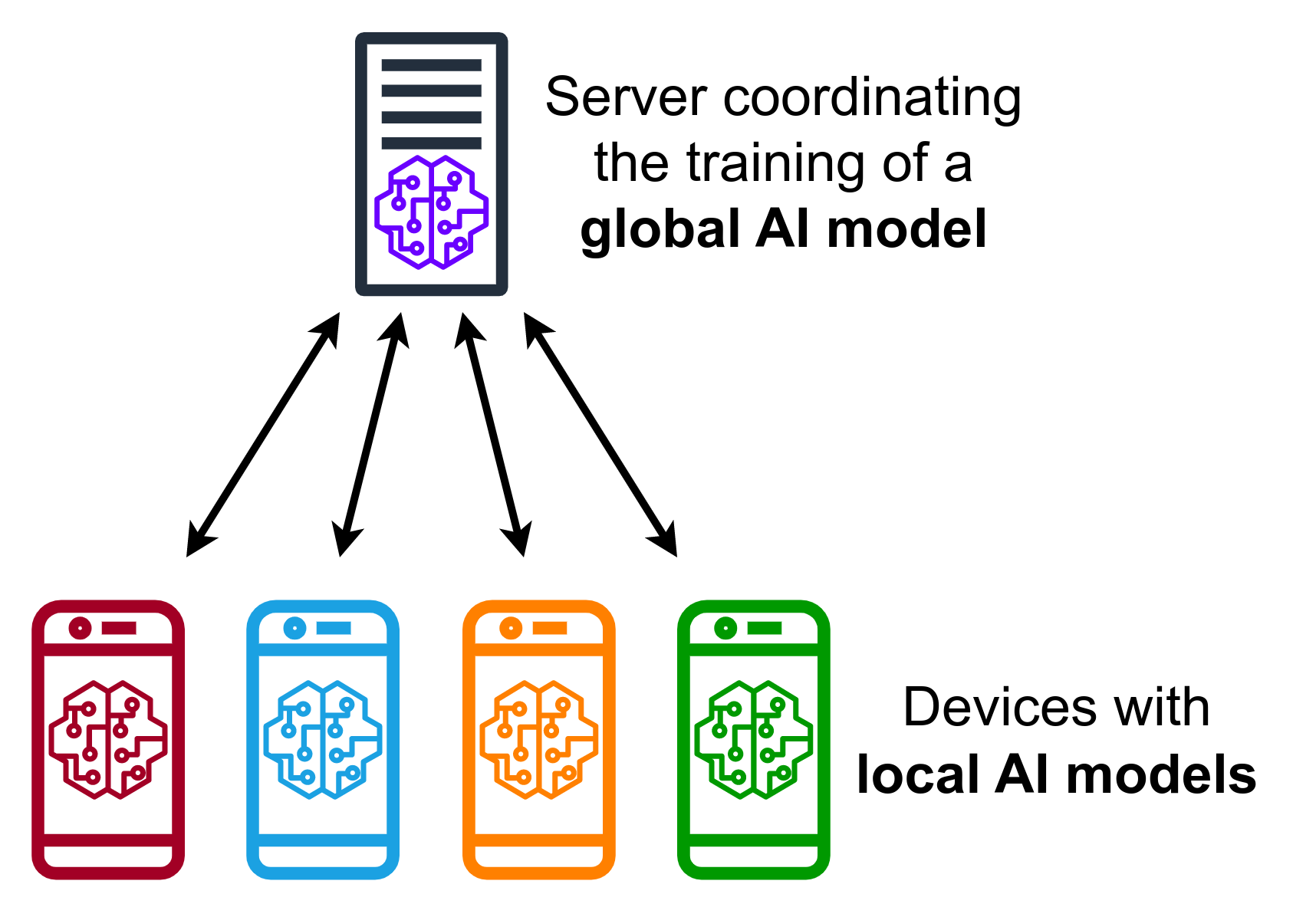
While on-device AI handles local processing, federated learning takes this concept a step further by enabling multiple devices to collaboratively train a shared AI model without ever exchanging their raw data. Instead of sending sensitive user data to a central server, each device downloads a copy of the global model, trains it locally using its own data, and then sends only the updates or changes to the model (e.g., aggregated weight differences) back to a central server.
The server then aggregates these updates from numerous devices to improve the global model, which is then redistributed for another round of local training. This iterative process allows the AI to learn from a vast, diverse dataset distributed across countless devices, all while keeping individual user data private and localized. This approach is particularly powerful for applications requiring learning from highly sensitive or proprietary data.
Recent Breakthroughs and Real-World Impact
Major technology companies are increasingly investing in and deploying these technologies across their product ecosystems. For instance, features like predictive text suggestions on mobile keyboards, personalized photo organization, and even health monitoring applications often leverage on-device AI and federated learning. These systems learn from individual user patterns to offer highly tailored experiences without uploading personal keystrokes, images, or health metrics to the cloud.
Recent advancements have focused on optimizing the efficiency of federated learning algorithms, making them more robust to varying network conditions and device capabilities. Researchers are also developing techniques to enhance the security and privacy guarantees of federated learning, such as differential privacy, which adds noise to model updates to further obscure individual contributions.
Consider a scenario where a global AI model needs to learn to identify rare medical conditions from patient data. Instead of centralizing sensitive patient records, hospitals could participate in a federated learning scheme, training the model on their local, anonymized datasets and contributing only the learned parameters.
# Conceptual representation of a federated learning update cycle
class Device:
    def __init__(self, local_data):
        self.local_data = local_data
        self.local_model = None

    def download_global_model(self, global_model_weights):
        self.local_model = load_model_with_weights(global_model_weights)

    def train_locally(self):
        # Train the local model on local_data
        # (This step does NOT share local_data)
        self.local_model.train(self.local_data)

    def get_model_update(self, initial_global_weights):
        # Calculate the difference (update) between local and initial global model
        return self.local_model.weights - initial_global_weights

class Server:
    def __init__(self):
        self.global_model_weights = initialize_model_weights()

    def aggregate_updates(self, list_of_updates):
        # Average or combine updates from all devices
        aggregated_update = sum(list_of_updates) / len(list_of_updates)
        self.global_model_weights += aggregated_update
        return self.global_model_weights

# Simplified Federated Learning Round:
# 1. Server sends global_model_weights to devices.
# 2. Each device downloads, trains locally, and sends back an update.
# 3. Server aggregates updates to improve global_model_weights.
This simplified code snippet illustrates how devices contribute only their model updates, not their raw data, to a central server for aggregation.
The Broader Implications for the Public
The widespread adoption of on-device AI and federated learning holds significant implications for the general public:
- Enhanced Privacy: Users can benefit from highly personalized AI experiences without the constant fear of their sensitive data being exposed or misused. This fosters greater trust in AI-powered services.
- Improved Performance: Local processing leads to faster response times and more seamless user experiences, especially in scenarios with limited or no internet connectivity.
- Democratization of AI: These technologies can enable AI applications in environments where data centralization is impractical or legally restricted, opening new avenues for innovation in healthcare, finance, and other sensitive sectors.
- Reduced Carbon Footprint: By performing computations locally and only sending small model updates, the energy consumption associated with massive cloud data transfers can be significantly reduced.
Challenges and the Road Ahead
Despite their promise, these technologies face challenges. Ensuring the fairness and robustness of models trained through federated learning, especially when device data distributions are uneven, remains an active area of research. The computational limitations of edge devices also dictate the complexity of models that can be effectively deployed on-device.
However, the trajectory is clear: the future of AI is increasingly moving towards a decentralized, privacy-first approach. As hardware continues to evolve and algorithms become more sophisticated, on-device AI and federated learning will become foundational pillars of our intelligent digital landscape, empowering users with both advanced capabilities and unparalleled data privacy.
References
- Google AI Blog. (Public Domain)
- Apple Machine Learning Journal. (Public Domain)
- Various academic papers on federated learning and differential privacy. (Creative Commons)